Floor Jack for Lifted Trucks: The Essential Guide to Safe and Effective Lifting
Floor Jack for Lifted Trucks: The Essential Guide to Safe and Effective Lifting
Lifted trucks are more than just vehicles; they are statements of capability, adventure, and personal style. Whether you’re navigating rugged trails, hauling heavy loads, or simply enjoying the commanding view, a lifted truck offers unique advantages. However, the very modifications that give these trucks their distinctive edge – increased ground clearance and larger tires – also introduce specific challenges when it comes to routine maintenance or emergency repairs. This is where the specialized floor jack for lifted trucks becomes an indispensable tool. Unlike standard floor jacks, which often fall short in both reach and lift height, these robust pieces of equipment are engineered to safely and efficiently raise your elevated vehicle, ensuring that essential tasks can be performed without compromise. Understanding their features, proper usage, and safety protocols is paramount for any lifted truck owner.
Understanding the Unique Needs of Lifted Trucks
Before delving into the specifics of floor jacks, it’s crucial to grasp why a standard jack simply won’t suffice for a lifted truck. The modifications that elevate your truck significantly alter its dynamics and requirements for lifting:
- Increased Ground Clearance: This is the most obvious factor. A standard floor jack’s maximum lift height is typically insufficient to even make contact with the frame or axle of a highly lifted truck, let alone raise a wheel clear of the ground.
- Heavier Weight: Lift kits often involve heavier components, and lifted trucks are frequently equipped with larger, heavier tires and accessories (winches, heavy bumpers, rock sliders), all contributing to a greater overall vehicle weight. This demands a jack with a higher weight capacity.
- Larger Tires: Even if a standard jack could reach the frame, lifting the vehicle high enough to remove a large, oversized tire requires significantly more vertical travel.
- Stability Challenges: The higher center of gravity of a lifted truck means stability during lifting is even more critical. A wide, stable base and secure lifting points are non-negotiable.
These factors necessitate a floor jack specifically designed to meet the demands of elevated vehicles, prioritizing both reach and lifting height, alongside robust construction and safety features.
Key Features of Floor Jacks for Lifted Trucks
When selecting a floor jack for your lifted truck, several key features differentiate specialized models from their standard counterparts:
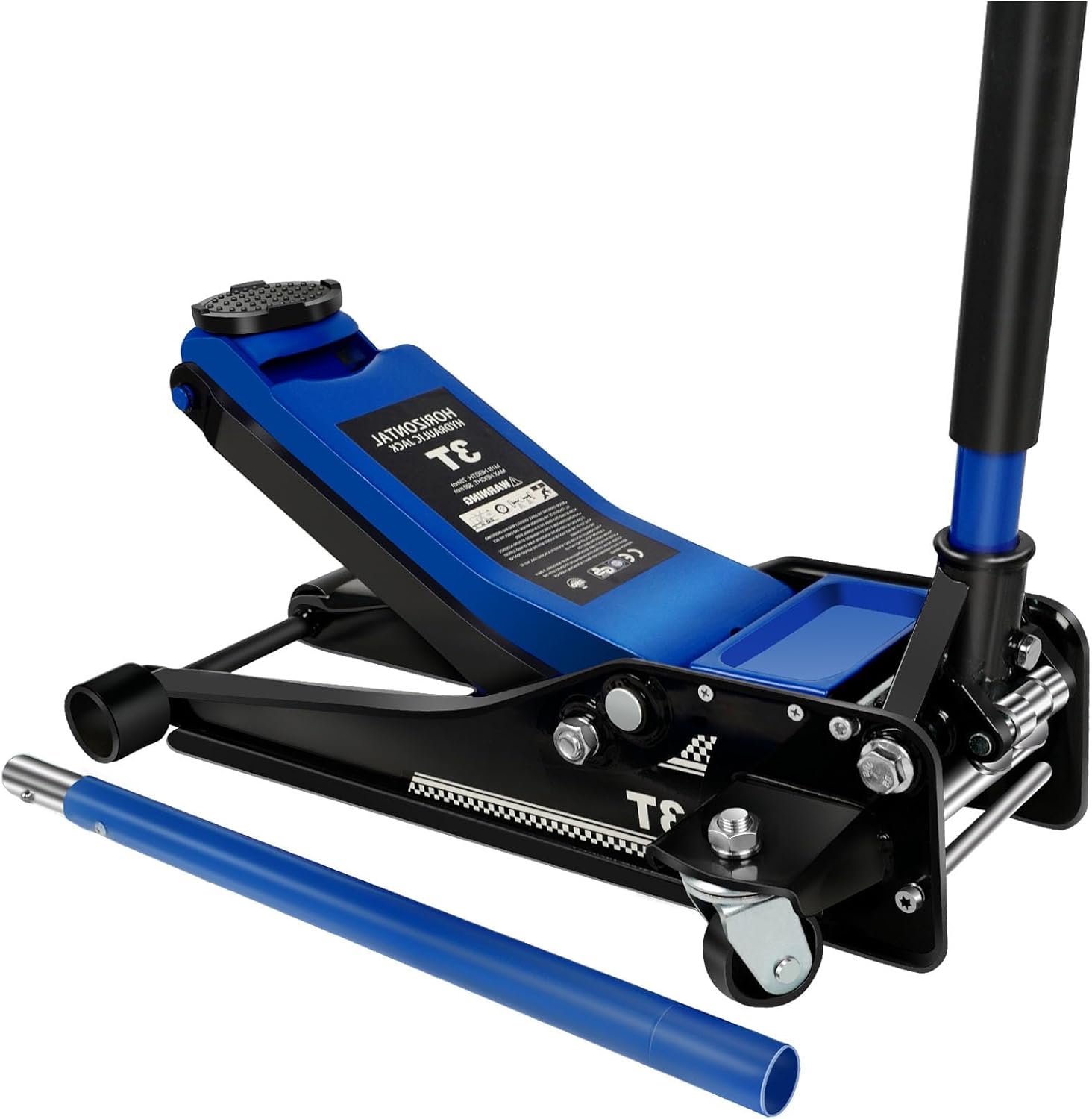
- Maximum Lift Height: This is arguably the most critical specification. A good floor jack for a lifted truck should offer a maximum lift height of at least 20-24 inches, and often more (up to 30 inches or even higher for extreme lifts). This ensures you can raise the vehicle sufficiently to clear even the largest off-road tires.
- Weight Capacity: Lifted trucks are heavy. Your jack’s capacity should always exceed your truck’s gross vehicle weight rating (GVWR). For most lifted trucks, a minimum of a 3-ton (6,000 lbs) capacity is recommended, with 4-ton or 5-ton options providing an extra margin of safety.
- Long Reach/Chassis: Due to the extended wheelbase and undercarriage protection on many lifted trucks, reaching ideal jacking points (like frame rails or axle housings) can be challenging. Many specialized jacks feature a longer chassis or "reach" to position the saddle precisely where needed without straining or improper placement.
- Saddle Design: The saddle (the part that contacts the vehicle) should be wide, stable, and often come with a rubber pad to prevent damage to the vehicle’s frame or axle and provide better grip.
- Heavy-Duty Construction: These jacks are built to withstand significant stress. Look for models made from heavy-gauge steel, ensuring durability and longevity.
- Pumping Mechanism: Many high-quality jacks for lifted trucks feature a dual-piston or rapid pump mechanism, which allows for quicker lifting with fewer pump strokes, saving time and effort.
- Safety Features: Essential safety features include an overload valve (to prevent lifting beyond the rated capacity), a bypass system (to prevent over-extension of the ram), and a wide, stable base for enhanced stability.
Types of Floor Jacks Suitable for Lifted Trucks
While the term "floor jack for lifted trucks" generally refers to a specific category, there are nuances:
- High-Lift Floor Jacks: These are the most common and purpose-built solutions. They feature an extended hydraulic ram and often a longer handle for increased leverage, specifically designed to achieve significant vertical lift.
- Long-Reach Floor Jacks: While often overlapping with high-lift jacks, some models prioritize horizontal reach over extreme vertical lift, making them ideal for vehicles with deep undercarriages where access to jacking points is difficult.
- Off-Road Jacks (Farm Jacks/Hi-Lift Jacks): While not traditional floor jacks, these manual lever-style jacks are widely used by off-road enthusiasts for their extreme lift capabilities and versatility in challenging terrains. However, they are generally less stable and harder to control than hydraulic floor jacks and are not recommended for general shop use on flat surfaces due to safety concerns. For this article, we’ll focus on the hydraulic floor jack style.
Choosing the Right Floor Jack for Your Lifted Truck
Selecting the ideal jack requires careful consideration:
- Measure Your Truck’s Ground Clearance: Measure from the ground to your truck’s frame or axle at its lowest point. Your jack’s minimum saddle height must be able to slide under this.
- Determine Required Lift Height: Measure from the ground to the bottom of your tire. You’ll need to lift the truck at least this height, plus a few inches, to get the tire completely off the ground.
- Check Your Truck’s GVWR: Locate your truck’s Gross Vehicle Weight Rating (usually on the door jamb sticker). Choose a jack with a capacity that is at least 75% of your GVWR, or ideally, matches or exceeds it for maximum safety.
- Consider Your Usage: If you frequently work on your truck, invest in a higher-quality, more durable jack. For occasional use, a mid-range model might suffice.
- Evaluate Storage and Portability: High-lift jacks can be large and heavy. Consider where you will store it and if you need to transport it.
- Read Reviews and Research Brands: Look for reputable brands known for quality and safety.
How to Safely Use a Floor Jack on a Lifted Truck (A Step-by-Step Guide)
Safety is paramount when working with any vehicle, especially a lifted truck. Always follow these steps:
-
Preparation is Key:
- Flat, Level Surface: Always work on a hard, flat, and level surface. Uneven ground significantly increases the risk of instability.
- Engage Parking Brake: Ensure the parking brake is firmly engaged.
- Wheel Chocks: Place wheel chocks on the wheels that will remain on the ground and are diagonally opposite to the wheel being lifted. For example, if lifting the front right, chock the rear left wheel.
- Personal Protective Equipment (PPE): Wear safety glasses and gloves.
- Clear the Area: Ensure no obstructions or people are under or around the vehicle.
-
Locate Proper Jacking Points:
- Consult your truck’s owner’s manual for recommended jacking points. These are typically reinforced areas on the frame rails, solid axle housings, or designated lift points. Never jack on suspension components, differential covers, or body panels.
- For lifted trucks, these points might be harder to reach, emphasizing the need for a long-reach jack.
-
Position the Jack:
- Slide the floor jack under the designated jacking point. Ensure the saddle is centered and securely making contact with the jacking point.
- Ensure the jack’s handle has enough clearance to pump without hitting the truck or ground.
-
Lift Gradually and Monitor Stability:
- Begin pumping the jack handle slowly and steadily.
- As the truck begins to lift, constantly observe its stability. If you notice any shifting or instability, stop immediately and reassess.
- Lift the truck just high enough so that the wheel you intend to work on is completely clear of the ground, plus a small margin.
-
Insert Jack Stands – CRITICAL STEP:
- Once the truck is at the desired height, immediately slide appropriately rated jack stands under the vehicle, placing them next to the floor jack at another designated support point (e.g., frame rail or axle).
- Lower the truck slowly and carefully until it rests securely on the jack stands. The jack stands, not the floor jack, should bear the weight of the vehicle while you work. Never work under a vehicle supported only by a floor jack.
- For lifted trucks, ensure you have tall enough jack stands with adequate capacity.
-
Perform Work:
- With the truck safely supported by jack stands, you can now perform your maintenance or repair.
-
Lower Safely:
- Once your work is complete, slowly raise the truck slightly with the floor jack to relieve pressure on the jack stands.
- Carefully remove the jack stands.
- Slowly and in a controlled manner, lower the truck back to the ground using the jack’s release valve. Do not let it drop quickly.
- Remove the floor jack and wheel chocks.
Maintenance and Longevity Tips
To ensure your floor jack remains reliable and safe for years to come:
- Regular Inspection: Before each use, inspect the jack for any signs of damage, leaks, bent components, or loose hardware.
- Cleanliness: Keep the jack clean and free of dirt, grease, and debris, especially around the hydraulic ram and moving parts.
- Proper Storage: Store your jack in a dry, protected area to prevent rust and damage.
- Hydraulic Fluid: Periodically check the hydraulic fluid level and top it off or replace it according to the manufacturer’s recommendations. Use only the specified hydraulic jack oil.
- Lubrication: Lubricate pivot points and wheels as recommended by the manufacturer.
Challenges and Solutions
- Challenge: Insufficient Lift Height.
- Solution: Ensure you purchase a true "high-lift" or "super-high-lift" floor jack with a maximum lift height that significantly exceeds your truck’s ground clearance plus tire diameter.
- Challenge: Difficulty Reaching Jack Points.
- Solution: Opt for a "long-reach" floor jack that has an extended chassis to get under the deeper parts of your lifted truck’s frame.
- Challenge: Instability During Lifting.
- Solution: Always use wheel chocks, work on a perfectly flat surface, and ensure the jack saddle is perfectly centered on the jacking point. Never skimp on jack stand quality or placement.
- Challenge: Heavy Weight of the Jack Itself.
- Solution: High-capacity, high-lift jacks are inherently heavy. Look for models with large, robust wheels and sturdy handles for easier maneuverability. Some heavy-duty models might even feature foot pedals for quicker lifting.
Floor Jack for Lifted Trucks: Price Guide
Here’s a general price guide for floor jacks suitable for lifted trucks. Prices can vary significantly based on brand, features, materials, and retailer.
| Model/Brand (Example) | Max Lift Height (Inches) | Weight Capacity (Tons) | Reach/Chassis Length (Inches) | Special Features | Estimated Price Range (USD) |
|---|---|---|---|---|---|
| Basic High-Lift Jack | 20-22 | 3 | 24-28 | Standard hydraulic, steel construction | $150 – $250 |
| Mid-Range High-Lift Jack | 24-26 | 3.5 – 4 | 28-32 | Rapid pump, wider saddle, heavier duty steel | $250 – $400 |
| Professional High-Lift | 28-30+ | 4 – 5 | 32-36+ | Dual piston, long reach, heavy-duty wheels, premium seals | $400 – $700+ |
| Aluminum/Hybrid Jack | 20-24 | 3 | 26-30 | Lighter weight, often rapid pump | $300 – $600 |
| Long-Reach Low Profile | 20-22 | 3 | 35-40+ | Designed for low-profile access with extended reach | $350 – $550 |
Note: Prices are estimates and subject to change based on market conditions, sales, and specific features. Always verify specifications with the manufacturer or retailer.
Frequently Asked Questions (FAQ) about Floor Jacks for Lifted Trucks
Q: Can I use a standard floor jack for my lifted truck?
A: Generally, no. Standard floor jacks typically lack the necessary maximum lift height to get a lifted truck’s wheels off the ground and often have insufficient weight capacity for heavier lifted vehicles. This can be unsafe and ineffective.
Q: What’s the minimum lift height I need for my lifted truck?
A: To determine this, measure your truck’s ground clearance (from the ground to your frame/axle) and the radius of your largest tire. Your jack’s maximum lift height needs to be at least your ground clearance plus the full height of your tire, with a few extra inches for clearance. A minimum of 20-24 inches is usually required, but often more for highly lifted trucks.
Q: How much weight capacity do I need?
A: Always choose a jack with a weight capacity equal to or greater than your truck’s Gross Vehicle Weight Rating (GVWR). A common recommendation is to have a jack with a capacity of at least 75% of your GVWR, but exceeding it offers a safer margin. For most lifted trucks, 3-5 tons (6,000-10,000 lbs) is appropriate.
Q: Are jack stands absolutely necessary?
A: YES, absolutely. Never, under any circumstances, work under a vehicle supported solely by a floor jack. A floor jack is a lifting tool, not a support tool. Always use appropriately rated jack stands to support the vehicle’s weight once it’s lifted.
Q: Where are the safe jacking points on a lifted truck?
A: Always consult your truck’s owner’s manual for recommended jacking points. Generally, these are reinforced areas on the main frame rails, solid axle housings, or specific factory-designated lift points. Avoid jacking on suspension components, differential covers, or any unreinforced body parts.
Q: What’s the difference between a high-lift jack and a long-reach jack?
A: A high-lift jack primarily focuses on achieving a greater vertical lift height. A long-reach jack focuses on having an extended chassis to reach jacking points further under the vehicle. Many premium jacks for lifted trucks offer both high-lift and long-reach capabilities.
Q: Are aluminum floor jacks good for lifted trucks?
A: Aluminum jacks are lighter, making them more portable. While many aluminum jacks offer decent capacity, they might not always provide the extreme lift height or the robust, heavy-duty construction of steel jacks designed for very heavy lifted trucks. Always check the specific lift height and capacity.
Conclusion
For owners of lifted trucks, a specialized floor jack is not merely a convenience; it’s a critical safety tool and an essential part of responsible vehicle ownership. The unique demands of elevated ground clearance and increased weight necessitate a robust, high-capacity, and high-lift jack that can safely and effectively raise your vehicle for maintenance, repairs, or tire changes. By understanding the key features, choosing the right model, and meticulously following safe operating procedures, you empower yourself to confidently tackle tasks that would be impossible with standard equipment. Investing in the right floor jack for lifted trucks is an investment in your safety, your truck’s longevity, and your peace of mind on and off the road.