Best Jack for Lifted Trucks

Best Jack for Lifted Trucks
Lifted trucks offer an impressive stance, enhanced off-road capability, and often a commanding view of the road. However, their elevated chassis and increased weight present unique challenges when it comes to maintenance, tire changes, or any task requiring the vehicle to be lifted. A standard automotive jack simply won’t cut it. Choosing the best jack for lifted trucks isn’t just about convenience; it’s a critical safety decision that ensures you can properly and securely lift your vehicle without risk of damage or injury. This comprehensive guide will delve into everything you need to know to select the ideal jack for your elevated rig, ensuring you’re prepared for anything from a garage repair to an unexpected trailside flat.
Understanding the Unique Needs of Lifted Trucks
Before diving into specific jack types, it’s essential to grasp why lifted trucks require specialized lifting equipment. Their modifications inherently change the dynamics and requirements for jacking:
- Increased Ground Clearance: The most obvious factor. A standard jack designed for a passenger car simply won’t reach the frame or axle of a truck with a 4-inch lift or more. You need a jack with a significantly higher maximum lift height.
- Heavier Weight: Lift kits often involve larger tires and wheels, heavy-duty suspension components, and sometimes additional accessories like bumpers or winches, all of which add substantial weight. Your jack must have a higher weight capacity (often referred to as WLL – Working Load Limit) to safely support the vehicle. Always refer to your truck’s Gross Vehicle Weight Rating (GVWR) and ensure your jack’s capacity exceeds the weight you’ll be lifting.
- Larger Tires: Even if a jack can reach the frame, lifting it high enough to get a large, inflated off-road tire off the ground requires even more lift height.
- Off-Road Environments: For trail-side repairs, you’re often dealing with uneven, soft, or unstable ground, which demands a jack with superior stability and adaptability.
Ignoring these factors and attempting to use an undersized or under-capacity jack is extremely dangerous and can lead to serious accidents, damage to your vehicle, or personal injury.
Key Features to Look for in a Jack for Lifted Trucks
When evaluating potential jacks, keep these critical features in mind:
Maximum Lift Height
This is arguably the most crucial specification. Measure the distance from the ground to your truck’s frame or axle, then add the height of your largest tire’s radius to ensure you can lift the wheel clear of the ground. Many standard floor jacks top out around 18-20 inches, which is often insufficient for a lifted truck. Look for jacks offering 24 inches or more of lift, depending on your specific lift kit and tire size.
Weight Capacity
Always choose a jack with a weight capacity that comfortably exceeds the heaviest corner of your truck. While you’re not lifting the entire vehicle at once, you should consider the Gross Vehicle Weight Rating (GVWR) of your truck and ideally choose a jack rated for at least 1.5 to 2 times the weight of one corner (e.g., if your truck weighs 6,000 lbs, a 3-ton (6,000 lbs) jack is a minimum, but a 4-ton or 6-ton jack offers a safer margin).
Stability and Footprint
A wider base and sturdy construction contribute significantly to stability, especially on uneven surfaces. For off-road use, a jack that can maintain stability on soft ground is invaluable. Look for models with large, stable bases or robust designs.
Durability and Construction Materials
Heavy-duty steel construction is paramount for longevity and safety. Look for features like reinforced lifting arms, high-quality welds, and corrosion-resistant finishes (e.g., powder coating). A durable jack is an investment that will pay off over years of use.
Ease of Use and Portability
Consider where you’ll be using the jack most often. For garage use, weight and bulk might be less of an issue, but for trail recovery, a more portable and quickly deployable option is better. Features like quick-pump mechanisms, ergonomic handles, and solid wheels can enhance usability.
Safety Features
Prioritize jacks with built-in safety mechanisms. These can include overload valves to prevent lifting beyond the rated capacity, wide saddles that grip jacking points securely, and locking mechanisms that prevent accidental lowering.
Types of Jacks Best Suited for Lifted Trucks
Different types of jacks offer varying advantages and disadvantages for lifted trucks. Understanding these will help you choose the best fit for your needs.
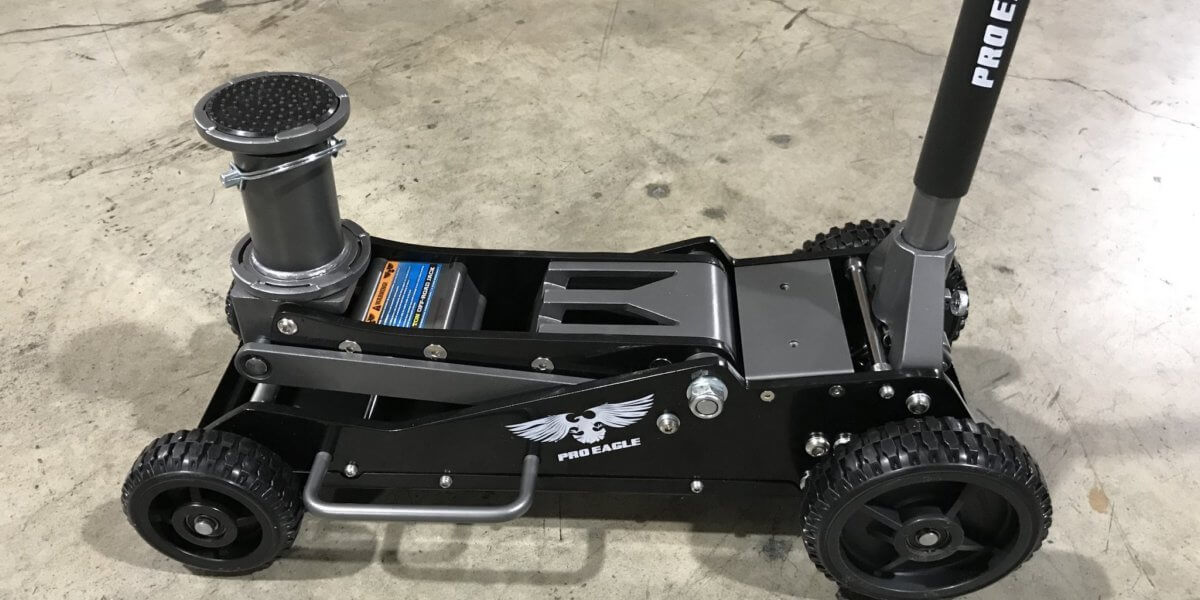
1. High-Lift Floor Jacks (Trolley Jacks)
These are essentially oversized versions of the standard floor jack, designed with longer lifting arms and higher maximum lift heights.
- Pros: Excellent stability on hard, level surfaces; smooth and controlled lifting/lowering; often have a wide saddle for secure contact; good for garage use.
- Cons: Very heavy and bulky, making them difficult to transport; can be expensive; limited effectiveness on soft or uneven terrain.
- Best For: Garage work, shop use, and situations where the truck can be driven onto a level, hard surface.
2. Bottle Jacks
Compact and powerful, bottle jacks use a hydraulic ram to lift vertically. Specialized versions exist that offer increased lift height.
- Pros: High weight capacity in a small footprint; relatively inexpensive; some models offer extension screws for added height.
- Cons: Limited maximum lift height compared to high-lift floor jacks (can be an issue for very high lifts); smaller contact pad can be less stable; can struggle with uneven surfaces.
- Best For: Truck beds, toolboxes, or when space is limited, especially for reaching axles or frame points on moderately lifted trucks. Look for models with a minimum 20-inch extended height.
3. Hi-Lift Jacks (Farm Jacks/Bumper Jacks)
Iconic in the off-road community, the Hi-Lift jack is a mechanical lever jack known for its extreme versatility and high lift capability.
- Pros: Exceptional lift height (often 48-60 inches); multi-functional (can be used for lifting, winching, clamping, or spreading); ideal for off-road recovery on uneven or soft terrain.
- Cons: Can be inherently unstable and dangerous if not used correctly; requires specific jacking points (e.g., rock sliders, reinforced bumpers, wheel adapters); heavy and awkward to store.
- Best For: Off-road adventures, trail recovery, and situations where traditional jacks cannot reach or operate. Requires careful training and strict adherence to safety protocols.
4. Exhaust Jacks / Airbag Jacks
These unique jacks inflate using your truck’s exhaust gases or an air compressor, lifting the vehicle via a large, durable bag.
- Pros: Excellent for soft, sandy, or muddy terrain where other jacks would sink; very high lift capacity; can lift multiple wheels at once.
- Cons: Requires the engine to be running (for exhaust models); susceptible to puncture from sharp objects; can be less precise in positioning; may not be suitable for all types of repairs.
- Best For: Off-road recovery on challenging terrain, especially sand, mud, or snow.
How to Safely Jack Up a Lifted Truck
Safety is paramount when working under any vehicle, especially a heavy, lifted truck.
- Park on a Level Surface: Always park on the firmest, most level ground available. If off-road, try to find the most stable spot.
- Engage Parking Brake and Chock Wheels: Ensure the parking brake is fully engaged. Place wheel chocks on the wheels that will remain on the ground (e.g., if lifting the front, chock the rear wheels).
- Locate Proper Jacking Points: Consult your truck’s owner’s manual or a reliable repair guide. Common jacking points include the frame rails, solid axle housing, or specific reinforced areas. Never jack on suspension components, differentials, or body panels.
- Position the Jack: Place the jack firmly under the chosen jacking point. Ensure the saddle makes full, secure contact.
- Lift Slowly: Raise the vehicle slowly and steadily, observing for any signs of instability.
- USE JACK STANDS: This step is non-negotiable. Once the vehicle is at the desired height, immediately place heavy-duty jack stands under a solid part of the frame or axle, next to the jack. Lower the jack until the vehicle rests securely on the jack stands. Never rely solely on a jack to hold the vehicle.
- Lower Carefully: When finished, lift the vehicle slightly with the jack to remove the jack stands. Then, slowly and carefully lower the vehicle to the ground. Remove the jack and wheel chocks.
Important Considerations and Tips
- Jack Stands are Your Lifeline: We cannot stress this enough. A jack is for lifting; jack stands are for supporting. Always use appropriately rated jack stands.
- Know Your Truck’s GVWR: Your truck’s Gross Vehicle Weight Rating is the maximum operating weight. Use this to determine the minimum capacity of your jack and jack stands.
- Purpose of Use: Are you primarily working in your garage, or do you need a jack for trail emergencies? This will heavily influence your choice.
- Accessories: Consider purchasing a jack pad (rubber or polyurethane) to protect your truck’s frame from scratches or damage from the jack saddle. For Hi-Lift jacks, wheel lift attachments can be incredibly useful.
- Maintenance: Keep your hydraulic jacks clean and lubricated. Check fluid levels periodically. Inspect mechanical jacks for wear and tear.
- Carry the Right Tools: Always have a base plate for Hi-Lift jacks (to prevent sinking on soft ground) and a pair of sturdy gloves.
Table: Estimated Price Ranges and Features for Jacks for Lifted Trucks
| Jack Type | Max Lift Height (Approx.) | Weight Capacity (Approx.) | Estimated Price Range ($) | Best For | Key Considerations |
|---|---|---|---|---|---|
| High-Lift Floor Jack | 22 – 30 inches | 3 – 6 tons | $200 – $600+ | Garage/Shop use, hard level surfaces | Heavy, bulky, excellent stability on flat ground |
| Heavy-Duty Bottle Jack | 18 – 24 inches | 6 – 20 tons | $50 – $250 | Truck bed/toolbox, moderate lifts | Compact, high capacity, can require extensions for max lift |
| Hi-Lift Jack (Farm Jack) | 48 – 60 inches | 3.5 tons (rated) | $100 – $300 | Off-road recovery, extreme lift situations | Highly versatile, requires training, can be dangerous |
| Exhaust/Airbag Jack | 20 – 30 inches | 4 – 8 tons | $150 – $400 | Soft terrain, sand, mud, snow recovery | Requires engine/compressor, puncture risk |
Note: Prices are estimated and can vary significantly based on brand, features, and retailer. Always check current pricing and specific model specifications.
Frequently Asked Questions (FAQ)
Q: Can I use a standard floor jack on my lifted truck?
A: Generally, no. A standard floor jack typically doesn’t have the necessary maximum lift height to get a lifted truck’s wheels off the ground, nor does it always have the capacity to safely lift a heavier truck. Using one could be dangerous and ineffective.
Q: How do I know what capacity jack I need?
A: Find your truck’s Gross Vehicle Weight Rating (GVWR) in your owner’s manual or on the driver’s side door jamb sticker. Your jack should have a capacity of at least half your GVWR, but ideally, choose a jack with a capacity of 1.5 to 2 times the weight of one corner of your truck for a safer margin. For example, a 6,000 lb truck should use a minimum 3-ton (6,000 lb) jack.
Q: Are Hi-Lift jacks safe?
A: Hi-Lift jacks can be safe when used correctly and with extreme caution. They are powerful tools but require proper training, understanding of their mechanics, and strict adherence to safety protocols. Incorrect use can lead to severe injury or death. Always use a stable base, ensure secure contact points, and never work under a vehicle supported only by a Hi-Lift jack.
Q: Where are the best jacking points on a lifted truck?
A: Always consult your truck’s owner’s manual. Common safe jacking points include the reinforced frame rails, solid front or rear axle housings (not the differential pumpkin itself unless specified), or designated jacking points often found on aftermarket bumpers or rock sliders designed for this purpose.
Q: Do I need jack stands if my jack has a locking mechanism?
A: Yes, absolutely. Even if a jack has a locking mechanism, it is still a hydraulic or mechanical device that can fail. Jack stands provide a separate, redundant, and more stable means of support, ensuring your safety while working under the vehicle. Never work under a vehicle supported only by a jack.
Conclusion
Selecting the best jack for lifted trucks is a crucial decision that impacts both your convenience and, more importantly, your safety. By understanding the unique demands of a lifted vehicle and carefully considering factors like maximum lift height, weight capacity, stability, and intended use, you can make an informed choice. Whether you opt for a robust high-lift floor jack for garage duties, a versatile Hi-Lift jack for off-road adventures, or a compact bottle jack for emergency roadside assistance, remember that safety features and the non-negotiable use of jack stands are paramount. Investing in the right jack isn’t just buying a tool; it’s investing in peace of mind and the ability to confidently maintain and repair your truck.
Learn more about selecting the best jack for lifted trucks here.